Big 'Bridgerton' Post
Season 4 Review, and the ingredients needed to make for a compelling historical romance in this beloved series

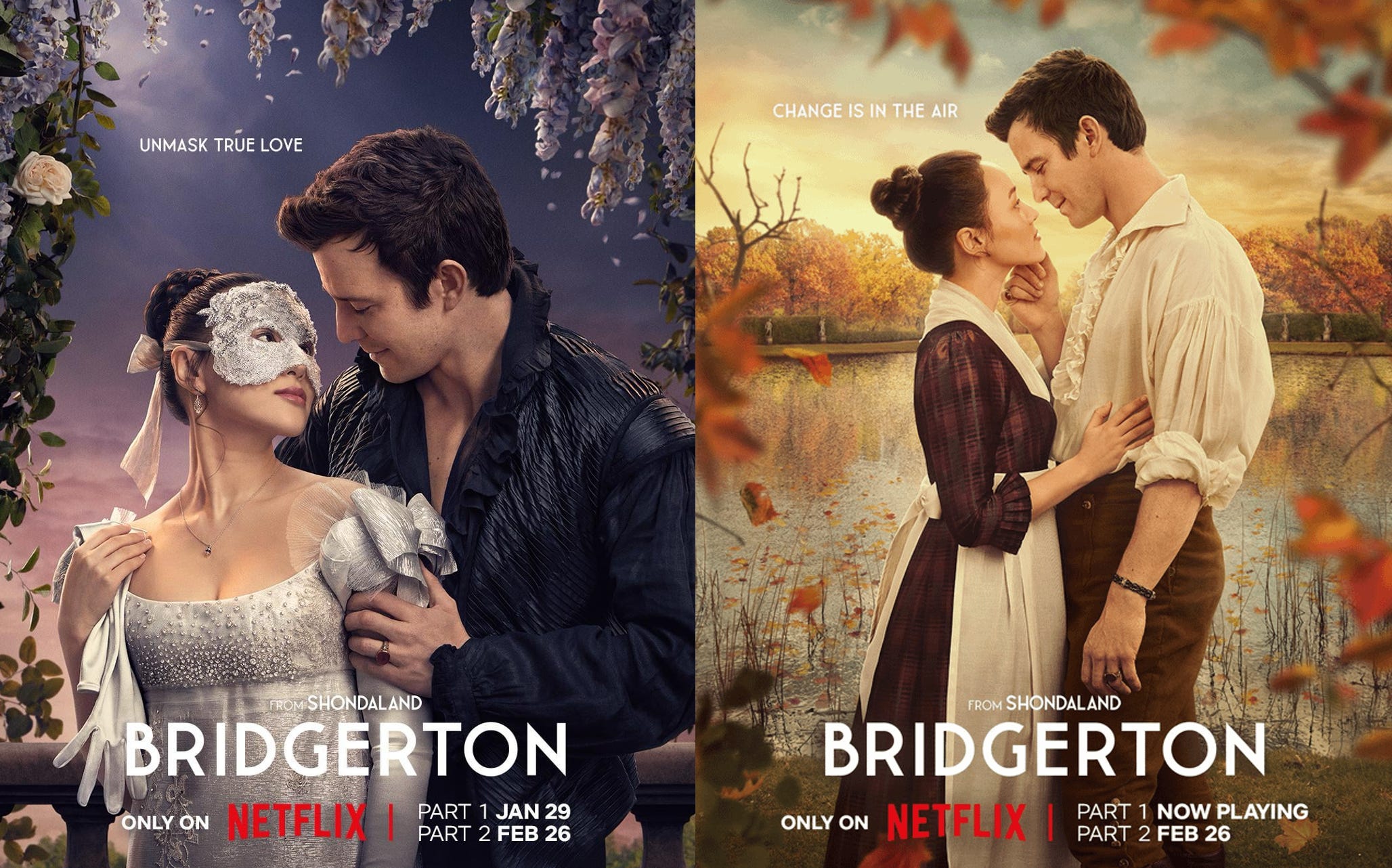
In a new tale from the ton, eternal bachelor Benedict Bridgerton finally meets his match: a captivating lady's maid in disguise at a masquerade ball.
Season four of Bridgerton - the historical romance family saga based on Julia Quinn’s book series - has just concluded, and it is by all accounts a smash-hit in the fandom.
I’m going to give a review of this fourth season, and put forward my theory on the best mindset to come to the book-series with, while also theorising why one season in particular was the least-successful, through no fault of the television adaptation.
Bridgerton Background
To remind everyone; Julia Quinn’s first novel in the Bridgerton series was The Duke and I, published in 2000 and releasing one-book-a-year for 6 years, concluding with On the Way to the Wedding in 2006.
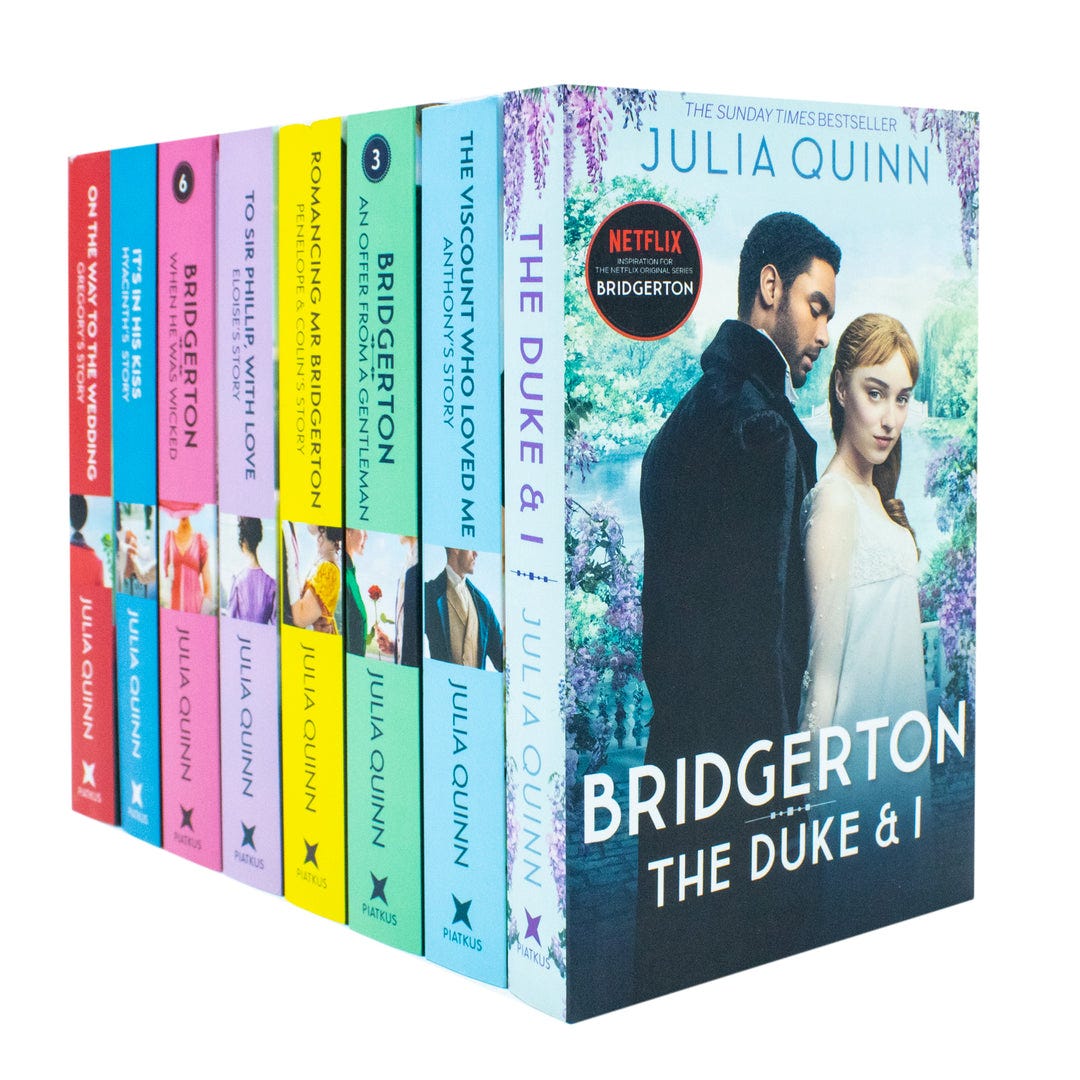
She has since published a spinoff-prequel series called The Rokesby Series which is about one generation before the Bridgertons and following the Rokesby family, who are neighbours and close friends of the Bridgertons.
The first book - Daphne and Simon’s - was adapted after Shonda Rhimes purchased the rights, following her 2017 exclusive, multi-year development deal with Netflix. The landmark agreement moved her production company, Shondaland, away from ABC to produce new series and projects exclusively for the streaming service. And Bridgerton was in fact the first project between Rhimes and Netflix, and has proven incredibly fruitful;
The fist season dropped at a tricky but fortuitous time, in December 2020 - becoming an instant smash-hit for the streamer.
While the covid period proved beneficiary for the first season and bingeing, the second season - Anthony and Kate’s - was hit with covid-positive setbacks;
Further delays came in 2023 with the Writers Guild of America strike;
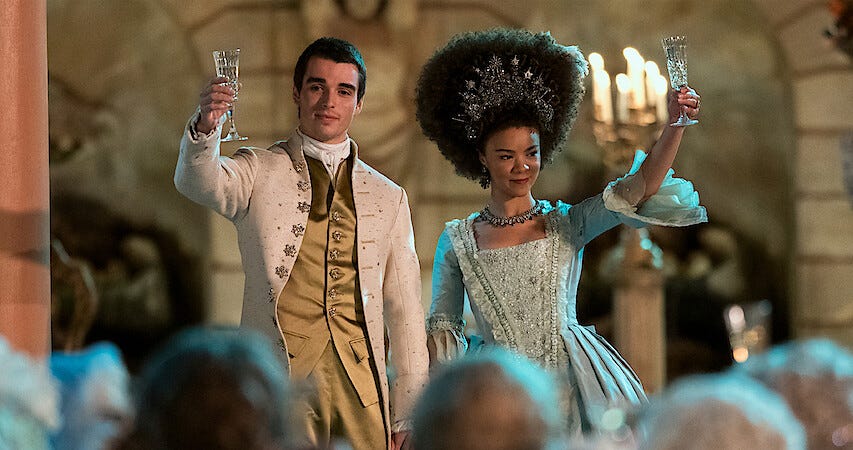
A highly-acclaimed spin-off series about Queen Charlotte and King George was written as an original one-season show by Rhimes and Quinn and aired in 2023, but when the third season of the show returned in 2024 - Colin and Penelope’s - the show aired in two-parts one-month apart, having been affected by the aforementioned filming-delays prior.
It is now a given that the show will air in two-parts every season, as happened this year for season four - Benedict and Sophie’s - and that there will continue to be a one-year hiatus after each season while production films.
And while rumours of another spinoff abound …
… nothing is confirmed
Bridgerton Books
As I have said elsewhere, I semi-enjoy Quinn’s Bridgerton series but it’s not my favourite. For the most part, I think it’s a case of the television show being better than the source-material and the book-to-TV changes have improved the universe.
For instance; Queen Charlotte is present in the books only superficially since it’s set during her reign, and Lady Danbury is a constant across the series as a somewhat loveable if meddling side-character - but the show has bolstered their roles, and solidified their friendship considerably.
And - of course - the biggest change from book-to-show is that under Rhimes’ production, the television series opted for open-casting and diverse actors to portray characters understood to be white in the books.
There’s a head-nod to history here that then bends into alternate-history, spinning around the real ambiguity over Queen Charlotte’s racial identity;
The show has been both praised and criticised for this anachronism, but it’s undeniable that it changed the landscape and scope of period-dramas forever;
Bridgerton’s first East Asian family is a beautiful thing, say cast
Is Bridgerton Woke? - Color-blind vs color-conscious casting in Hollywood
Quasi-color consciousness: Casting, race, and sexual violence in Netflix’s Bridgerton
‘Why is Bridgerton’s race twisting acceptable?’ The real problem with the show’s Black fantasy
Bridgerton doesn’t really do “poor”, but the real elephant in the ballroom is slavery. At the time Queen Charlotte takes place, the brutal mechanics of the slave trade were in full swing. The abolitionist movement was just getting started, but the slave trade was not legally abolished in the British empire until 1807, and slavery itself not until 1833. During George III’s reign, 1.5 million Africans were captured and shipped to plantations in North America and the Caribbean. In 1800, the slave trade made up more than 10% of Britain’s GDP. These are the ill-gotten riches on which Bridgerton’s (and Britain’s) world of palaces, parties and gigantic wigs was built, but in the show itself, this side of the story is ignored. There are a few tiny references to “the colonies”, but slavery, human rights and abolition are never mentioned.
“It’s an absurd take on Black history,” says Steven I Martin, Black British author and historian. “It is set at a time when Britain was the largest trader in human lives on the planet. Slavery was central to the British economy.” Martin accuses Bridgerton of “inviting, or fomenting, the forgetting or overlooking of the realities of that period”.
The books also follow a classic family-saga structure where upcoming couples are mentioned, and continue to make appearances even after their story-arc has concluded. Bridgerton the show has much more adeptly interwoven multiple storylines simultaneously, even if the show has had to tweak the familial aspect due to departing actors;
However, I have made a video about the fact that the biggest and most compelling change from the books-to-television is that the show has made the Bridgerton siblings - the men in particular - far more bearable for television.
But overall, the Bridgerton siblings are generally the worst characters in their own books. Yes, even the sisters - Daphne in her first season commits sexual assault against her sleeping husband, just as portrayed in the book too;
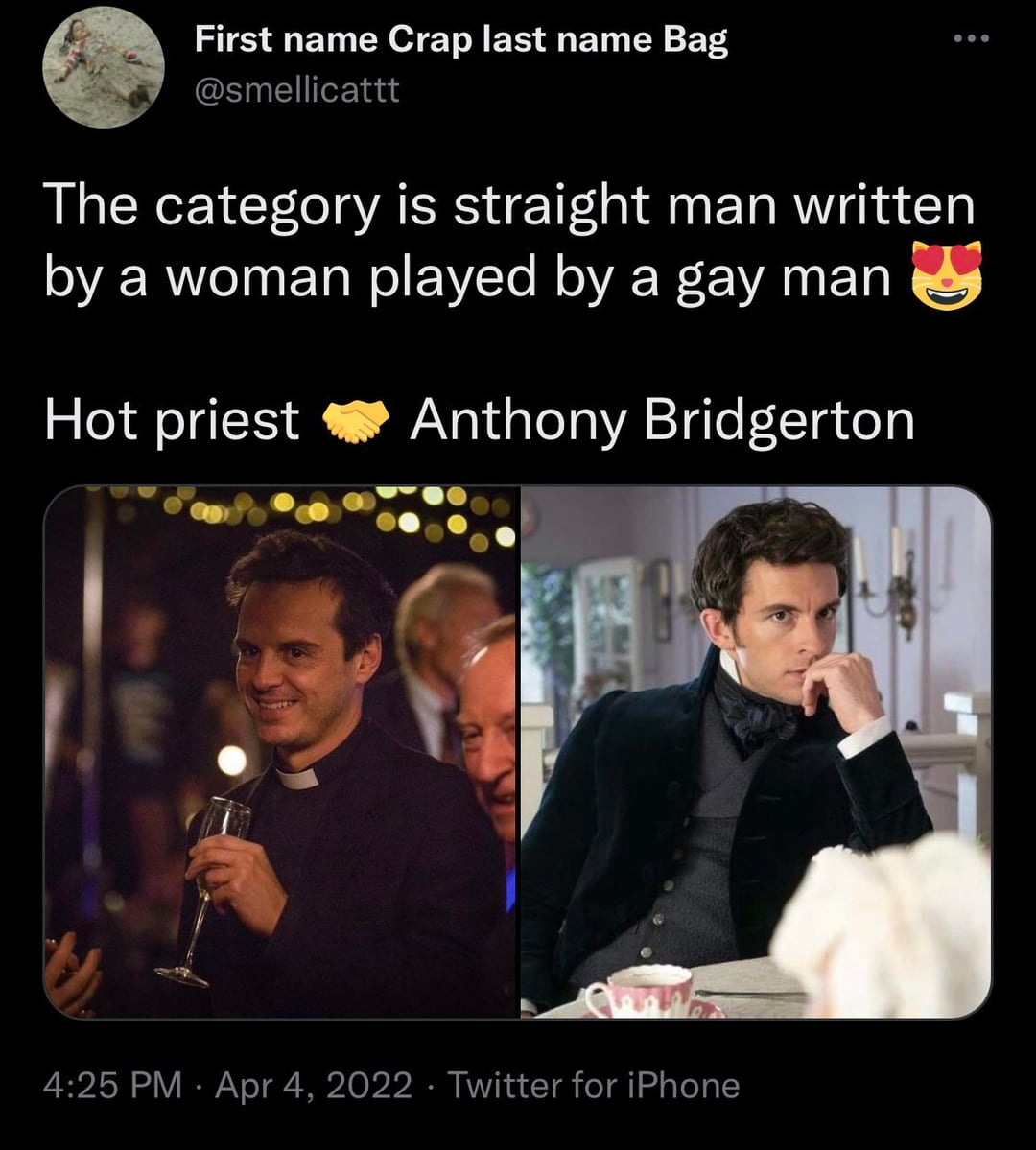
Anthony in the second book is physically rough with his intended, Kate, on multiple occasions - the character greatly improved in season two by the actor portraying him being played by Jonathan Bailey, which just goes to show the old meme is true;
And even Benedict Bridgerton - the subject of third book, An Offer from a Gentleman, but the fourth season - repeatedly and annoyingly pressures a woman to become his mistress in the book, but is once again greatly improved by more nuanced writing and acting in the show.
For more on the book-to-screen adaptations, I enjoy Dominic Noble’s Bridgerton ~ Lost in Adaptation YouTube series.
Bridgerton Season Four
Season four of Bridgerton is indeed Benedict’s story, and it borrows heavily from not only the ‘forbidden love’ trope, but specifically; Cinderella.
From the book blurb;
Sophie Beckett never dreamed she’d be able to sneak into Lady Bridgerton’s famed masquerade ball—or that “Prince Charming” would be waiting there for her! Though the daughter of an earl, Sophie has been relegated to the role of servant by her disdainful stepmother. But now, spinning in the strong arms of the debonair and devastatingly handsome Benedict Bridgerton, she feels like royalty. Alas, she knows all enchantments must end when the clock strikes midnight.
Ever since that magical night, a radiant vision in silver has blinded Benedict to the attractions of any other—except, perhaps this alluring and oddly familiar beauty dressed in housemaid’s garb whom he feels compelled to rescue from a most disagreeable situation. He has sworn to find and wed his mystery miss, but this breathtaking maid makes him weak with wanting her. Yet, if he offers his heart, will Benedict sacrifice his only chance for a fairy tale love?
In the TV series, Benedict is played by theatre-trained Luke Thompson, and Sophie Beckett becomes Sopihe Baek, played by Korean-Australian actor Yerin Ha;
And I’ve got to say … An Offer from a Gentleman has long been my favourite book of Julia Quinn’s series, and I am deeply unsurprised that it is also - in my humble opinion - the best season of the TV show thus far.
A lot of that has to do twofold with the familiar plot-pattern of the Cinderella storyline, and the first time that this universe - which focuses on a titled family - has cast their eyes downward to the “lower-classes” in an upstairs-downstairs narrative … but, in all honesty, 90% of the season four success is down to the chemistry of the two leads playing Benedict and Sophie. As Shonda Rhimes herself praised Thompson and Ha; “To me, they have a chemistry like no other.”

Their press-tour in particular has been delightful to watch. Not just to see everyone speak so glowingly about Yerin Ha’s performance and sunshine-y personality on set, but to have Luke Thompson speak so earnestly and profoundly on the need for intimacy-coordinators has even been refreshing and sorely needed. As well as being bereft at the thought of no more Bridgerton for one year now that this season has concluded, I’m even sad to think we won’t get this level of press-tour hijinks and hilarity;
I even think the show has made fantastic decisions in evolving the friendship between Lady Danbury and Queen Charlotte this season, and continuing to interweave Francesca Bridgerton’s story - from her book, When He Was Wicked - just as they did previously in season three, when they laid the groundwork for her tale … which comes to a sad conclusion, and new chapter in season four.
All of these decisions made for a really rich and multilayered season, full of extreme highs and lows - pulling out melodrama and tragedy that feels like it was somewhat missing from Colin and Penelope’s third season, by comparison …
Bridgerton needs complexity
I think people often mistake the Romance genre - and Historical Romance - for staid and safe, when its drawcard is often the exact opposite.
One of the reasons we love reading and watching Historical Romance isn’t just for the ballgowns, and charming courtship - it works best when the restraints and constraints of the time provide interesting barriers and limitations for the characters. We like the rigid social-structures to dictate stakes and drama, how front-and-centre the class-warfare is and the predicaments they throw characters into. I completely agree with Shonda Rhimes’ take on this, and I think it’s why she understood the mechanics of the universe so well;
“I didn’t see it as a romance,” she says. “It was more of a workplace drama.
“The women don’t have power in other areas of their lives, the power is in how they marry, so it becomes a workplace. And that’s where the drama is.
“More importantly, I could see myself in them. If a black woman in 21st century America can see herself in regency England, it’s a good story.”
I’d even venture to say that the most successful Bridgerton seasons are the ones that amplify these barriers and dramas, and put the deeply personal on full-display for all of society to see and commentate on - it’s a version of how we all see our problems and innermost battles and demons, terrified that everyone is watching and judging us for our foibles.
A break-down of the protagonists of each season, and their inner struggles and stakes and how they play on a public stage;
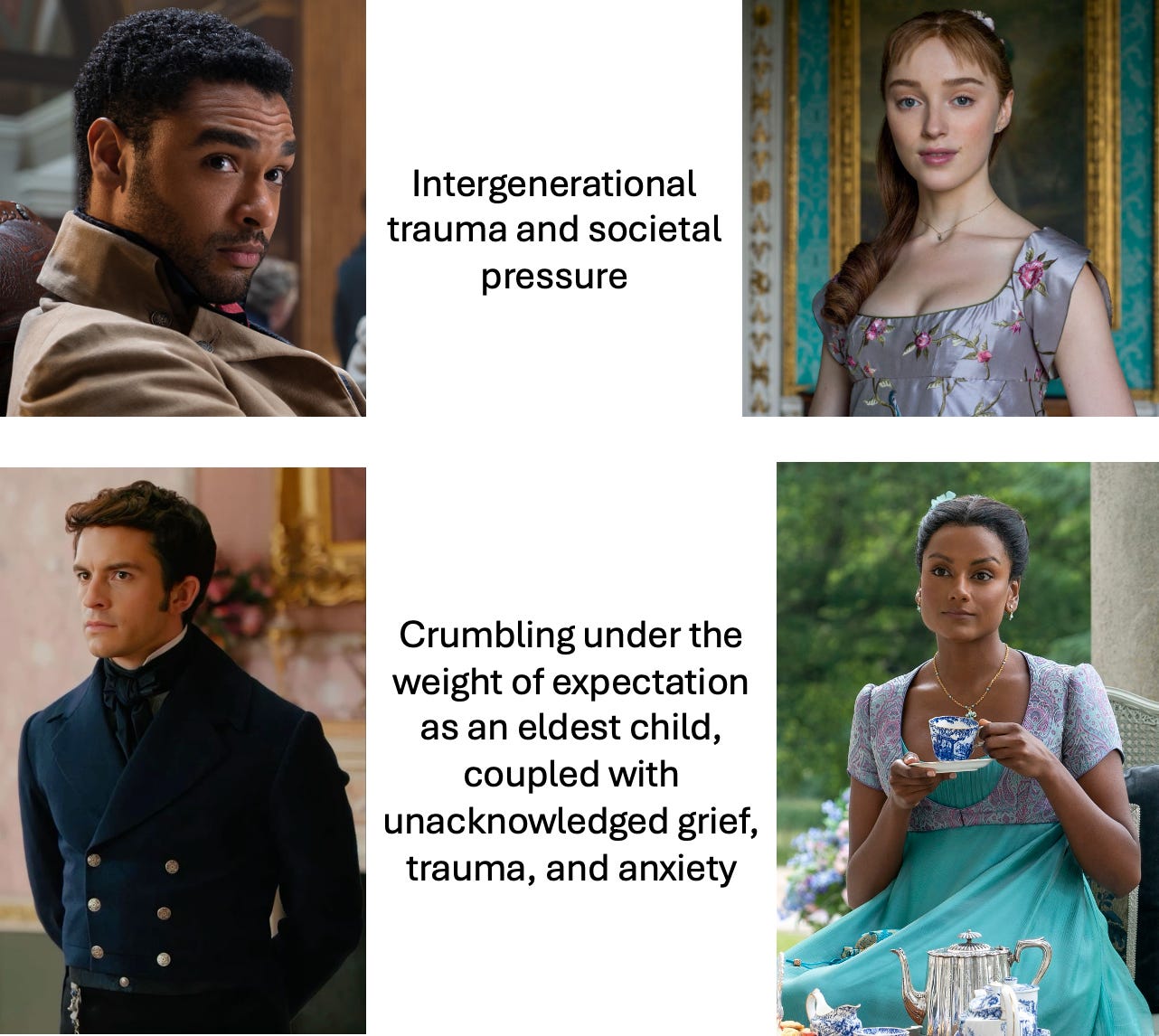
And this also goes some way to explaining why season three of Bridgerton was both the worst book, and destined to be the worst season. Romancing Mister Bridgerton is about;
Colin Bridgerton is tired of being thought nothing but an empty-headed charmer, tired of the neverending sameness of his life, and, most of all, tired of everyone’s preoccupation with the notorious gossip columnist Lady Whistledown, who can’t seem to publish an edition without mentioning him in the first paragraph. But when Colin returns to London from a trip abroad, he discovers nothing in his life is quite the same—especially Penelope Featherington! The girl who was always simply… there is suddenly the girl haunting his dreams. But when he discovers that Penelope has secrets of her own, this elusive bachelor must decide…is she his biggest threat—or his promise of a happy ending?
It’s a friends-to-lovers, unrequited-love trope book and sadly on the Bridgerton stage it doesn’t stack up against its siblings. The television show somewhat improved Colin (played by Luke Newton) and Penelope’s (Nicola Coughlan) story - mostly by not insisting that Penelope’s makeover hinge on weight-loss as it did in the novel, and by the sheer star-power of the two leads who did an admirable job with meh material.
But the real issue was that the stakes were as low as Colin’s personality is shallow - probably because the book came out in 2002 at the height of “The Makeover” movie-trope (She’s All That and The Princess Diaries) and it does feel quite stuck in an early-00s body dysmorphia quagmire that does huge disservice to both romantic leads.
Compared to his siblings, Colin’s issues aren’t enough to sink your teeth into for a full season, and probably needed considerably more layers of complexity to stack up against Penelope’s far more interesting storyline … I firmly believe the fault mostly lies with Colin being so subpar, and the book itself being the worst of the lot;
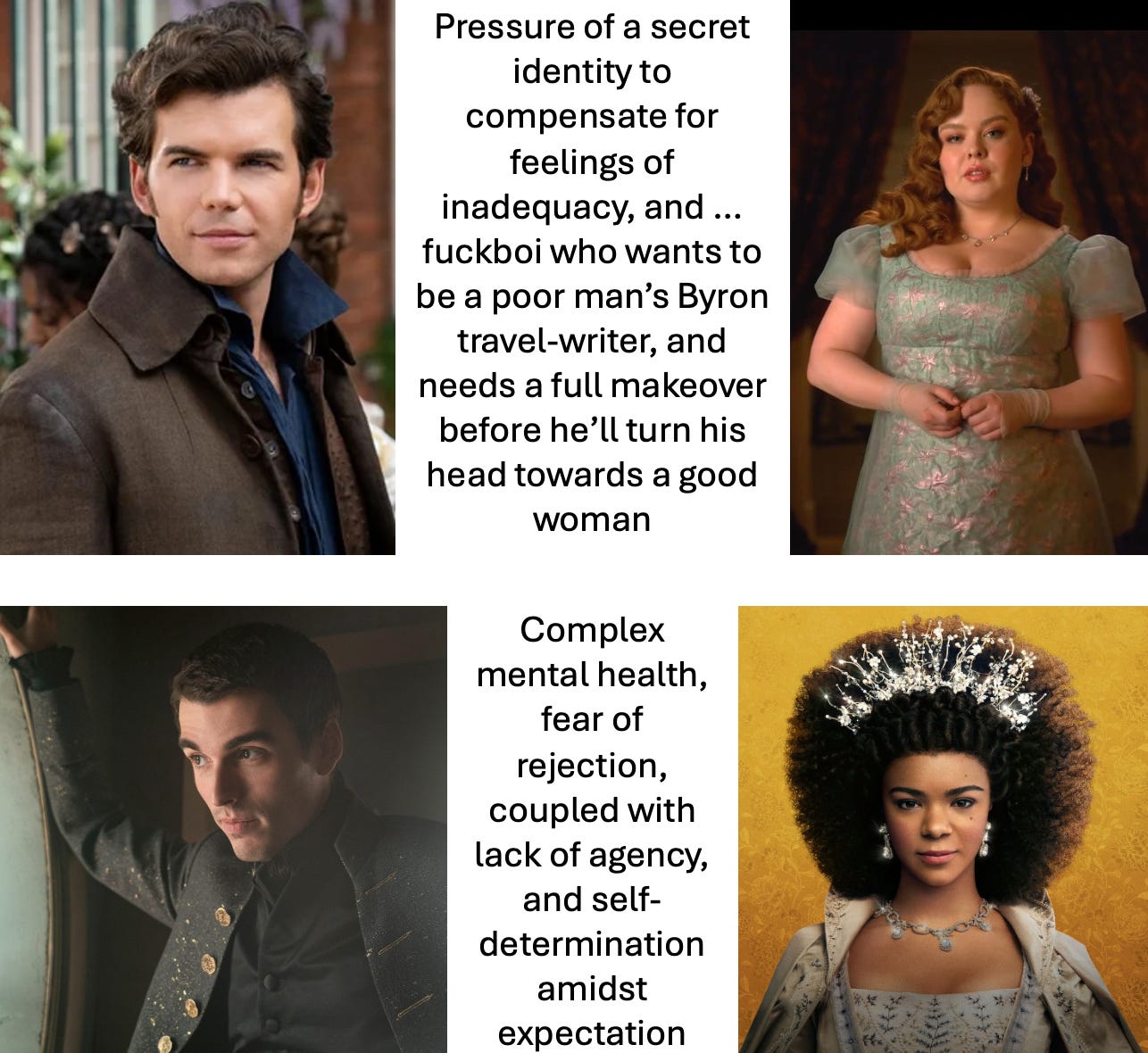
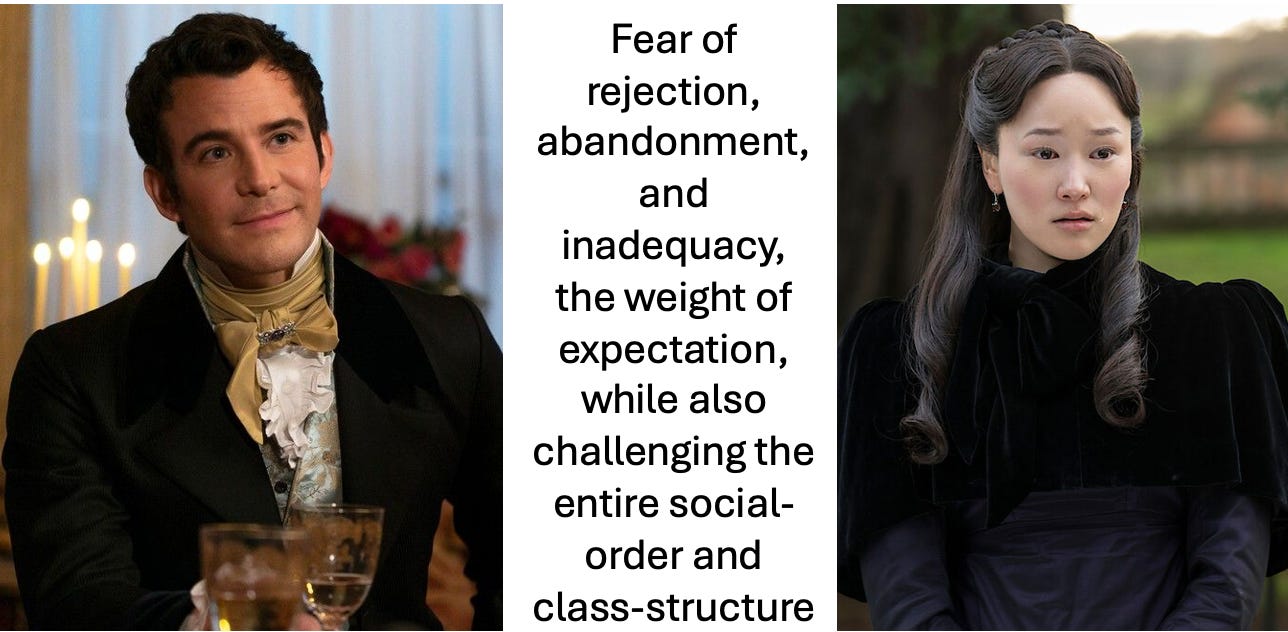
Part of the reason Benedict and Sophie work so well - enough to possibly take the crown of best season pair - is that they are overcoming more than their personal inner-conflicts, but also huge external ones (y’know, just the whole way that society is structured and conspiring to keep them apart).
I’d say my second-favourite couple in the Bridgerton universe is Charlotte and George - again, partly because actors India Amarteifio, and Corey Mylchreest had incredible chemistry with perhaps the best declaration of love - but mostly because it perfectly balanced inner-turmoil and outer-conflict, using the weight of the crown and dedication to the kingdom alongside complex mental health struggles … it felt impossible, and had great pathos amongst the fabulous romance.
Benedict and Sophie’s season has likewise perfected this recipe, and I am extremely hopeful that the groundwork of sadness already laid for Francesca and Eloise Bridgerton - in very different, but no less profound ways - will see their seasons on similar addictive melodramatic rollercoasters;
The key to Historical Romance - like all good narratives - is to have stakes worth fighting for, and obstacles that seem insurmountable. And to do as Rhimes and never forget; the ton is basically an industry and Bridgerton a workplace-drama taking place in its corridors.
Totally agree this was the most narratively satisfying season - and the Cinderella element and class stakes played a big part. I love Nicola Coughlan, and was so excited for season three, but it was so let down by what Mina Le described as a 'yassified' Colin. He lost all his goofiness and became a bit of a self-righteous Ken Doll. (Still pretty boring this season too, though at least more supportive of Pen.)
This is wonderful! You have perfectly encapsulated and bettered all the jumbled up Bridgerton thoughts in my head - thank you!