Scammers targeting emerging and published writers -- BEWARE!
Email scams are at an all-time high and they are predicated on your desire for publishing success

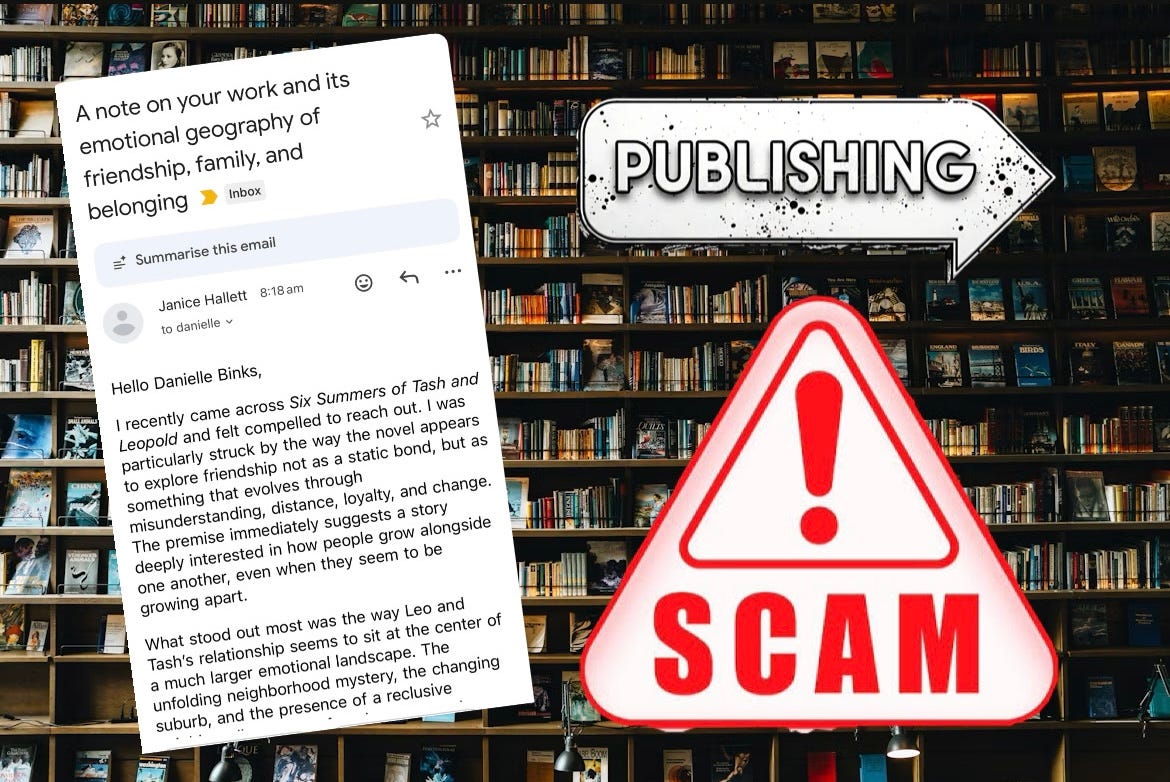
The Lonely-Hearts-Honeypot-Catfish Publishing Scams
Publishing is currently the target of unprecedented levels of scams, made easier and more nuanced by Artificial Intelligence being able to generate and target all corners of our industry.
And these scams are defying borders; they are instead inflitrating the wider publishing landscape, as a whole;
SoA and Writers’ Guild issue ‘urgent’ author guidance after ‘explosion’ of AI scams
No, Colleen Hoover didn’t email you. Authors face new barrage of email and AI scams.
Scam emails impersonating editors ‘on the rise’ as author vigilance urged
Authors hit with ‘deluge’ of scam emails from fake marketers offering paid promotion
The Guardian investigative piece into the targeting of self-published authors, really succinctly hits on the shape these scams are taking; “New wave of publishing scams mimic lonely hearts hoaxes of old – swapping promises of true love for the fantasy of literary acclaim. And the wooing process is now fully automated.”
It’s not just that these scammers - like “lonely hearts hoaxes of old” are flattering egos and writing exactly what we all want to hear about our talents, but it’s that AI is making their spiels eerily convincing.
The Australian Society of Authors warned of this too, back in October 2025;
With the increased availability of AI tools, email scams are becoming more personalised, realistic, and targeted, using AI-generated copy to address you by name and provide details of your book, giving the impression they are a real person who has read your work. Gone are the days where scams were easily identifiable by spelling errors, strange formatting, and impersonal salutations. The use of AI is making scams more sophisticated, so our ways of identifying them need to evolve too.
Julian Sancton writing for The Hollywood Reporter notes that; “with their blend of ego and insecurity, writers are ideal marks for swindlers promising fortune and glory. Chatbots have turbocharged the con.”
I can attest to this, as someone who sits at a few intersections of these scams as both an author and literary agent - and I have been receiving 2-3 scam emails a week, for the last couple of months.
I thought to walk you through these scam emails, their con, and reiterate that; if it sounds too good to be true, it probably is.
The Manuscript Scam
I got the following email with subject line; A Thoughtful and Timely Voice in Middle Grade Storytelling
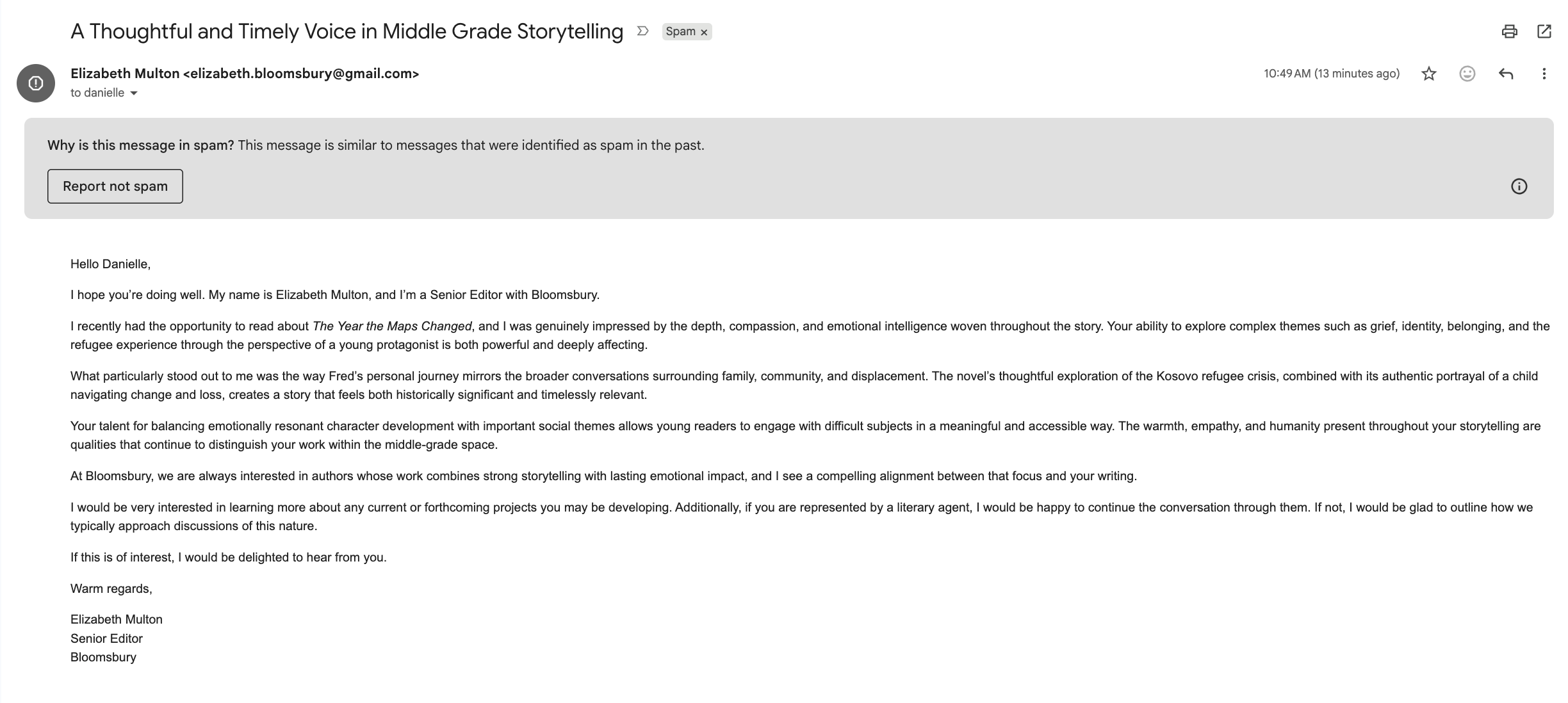
Because the screenshot is a little small and hard to read, here is a replication of the body of the email;
Hello Danielle,
I hope you’re doing well. My name is Elizabeth Multon, and I’m a Senior Editor with Bloomsbury.
I recently had the opportunity to read about The Year the Maps Changed, and I was genuinely impressed by the depth, compassion, and emotional intelligence woven throughout the story. Your ability to explore complex themes such as grief, identity, belonging, and the refugee experience through the perspective of a young protagonist is both powerful and deeply affecting.
What particularly stood out to me was the way Fred’s personal journey mirrors the broader conversations surrounding family, community, and displacement. The novel’s thoughtful exploration of the Kosovo refugee crisis, combined with its authentic portrayal of a child navigating change and loss, creates a story that feels both historically significant and timelessly relevant.
Your talent for balancing emotionally resonant character development with important social themes allows young readers to engage with difficult subjects in a meaningful and accessible way. The warmth, empathy, and humanity present throughout your storytelling are qualities that continue to distinguish your work within the middle-grade space.
At Bloomsbury, we are always interested in authors whose work combines strong storytelling with lasting emotional impact, and I see a compelling alignment between that focus and your writing.
I would be very interested in learning more about any current or forthcoming projects you may be developing. Additionally, if you are represented by a literary agent, I would be happy to continue the conversation through them. If not, I would be glad to outline how we typically approach discussions of this nature.
If this is of interest, I would be delighted to hear from you.
Warm regards,
Elizabeth Multon
Senior Editor
Bloomsbury
And the associated email is; elizabeth.bloomsbury@gmail.com
I knew in particular that the Bloomsbury one was a scam because;
1.) Being a literary agent, I know that Bloomsbury has no editorial team in Australia or any interest in approaching already published Aussie authors, but the publicists I have had correspondence with have a totally different email configuration and definitely don’t use Gmail, and;
2.) I had heard through the grapevine that Bloomsbury were aware that their publishing house was being used as a honey-pot front for such scams, and had put out a detailed page on their website trying to address the issue and stop people from being duped;
So what is the point of such scams?
The stinger is in conclusion of the email; I would be very interested in learning more about any current or forthcoming projects you may be developing. Additionally, if you are represented by a literary agent, I would be happy to continue the conversation through them. If not, I would be glad to outline how we typically approach discussions of this nature.
I think the desire to be introduced to your literary agent is to secure that email address for future scams (most likely assuming the identity of that agent) but more importantly, I’d suggest; they want you to send your work-in-progress manuscript.
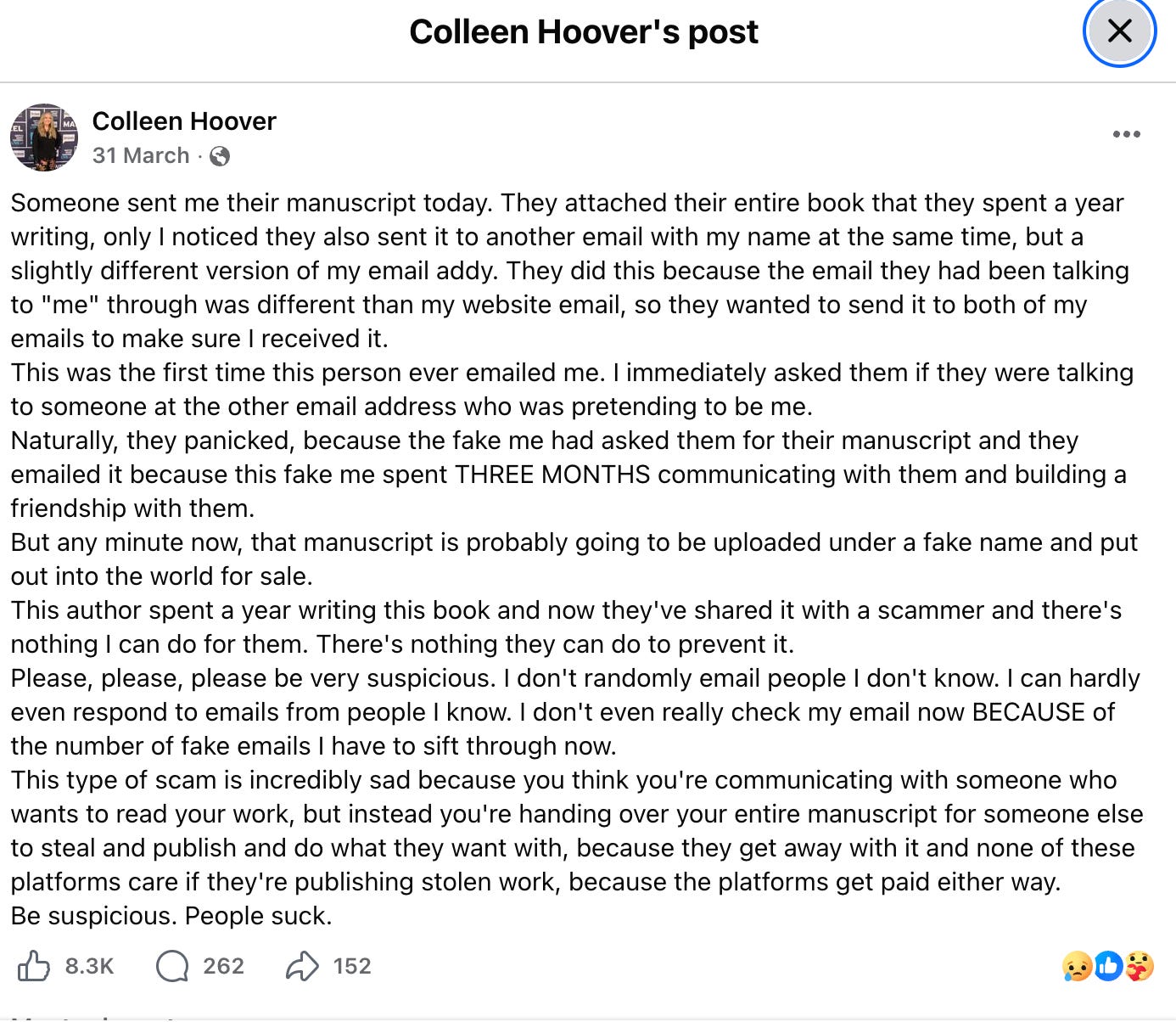
This is the shape a lot of these scams have been taking, particularly one involving a fake email from Colleen Hoover wanting you to share your manuscript with her. From the USA Today article;
An aspiring author had sent Hoover their manuscript, also copying a fraudulent email impersonating Hoover on the email chain. The author had been communicating with the impersonator for three months, thinking it was Hoover.
“But any minute now, that manuscript is probably going to be uploaded under a fake name and put out into the world for sale,” Hoover wrote on Facebook. “This author spent a year writing this book and now they’ve shared it with a scammer and there’s nothing I can do for them. There’s nothing they can do to prevent it.”
Hoover was obviously distressed about this, and made the situation public on her Facebook account;
Her assumption is indeed that the scammers wanted the manuscript to sell (or strip for AI-training, who knows?!) either way; a work of your intellectual property in the hands of scammers adept at using AI is a frightening creative prospect, given;
I have not received the Hoover scam email, but I assume because I have many public-facing book-related social media accounts (like this Substack, my old blog, Goodreads and StoryGraph) that scammers tailored the scam to my preferences … which is in itself chilling to realise they’re aware I’m not a Colleen Hoover reader, they instead modulated such an email to an author I do love; Janice Hallett.
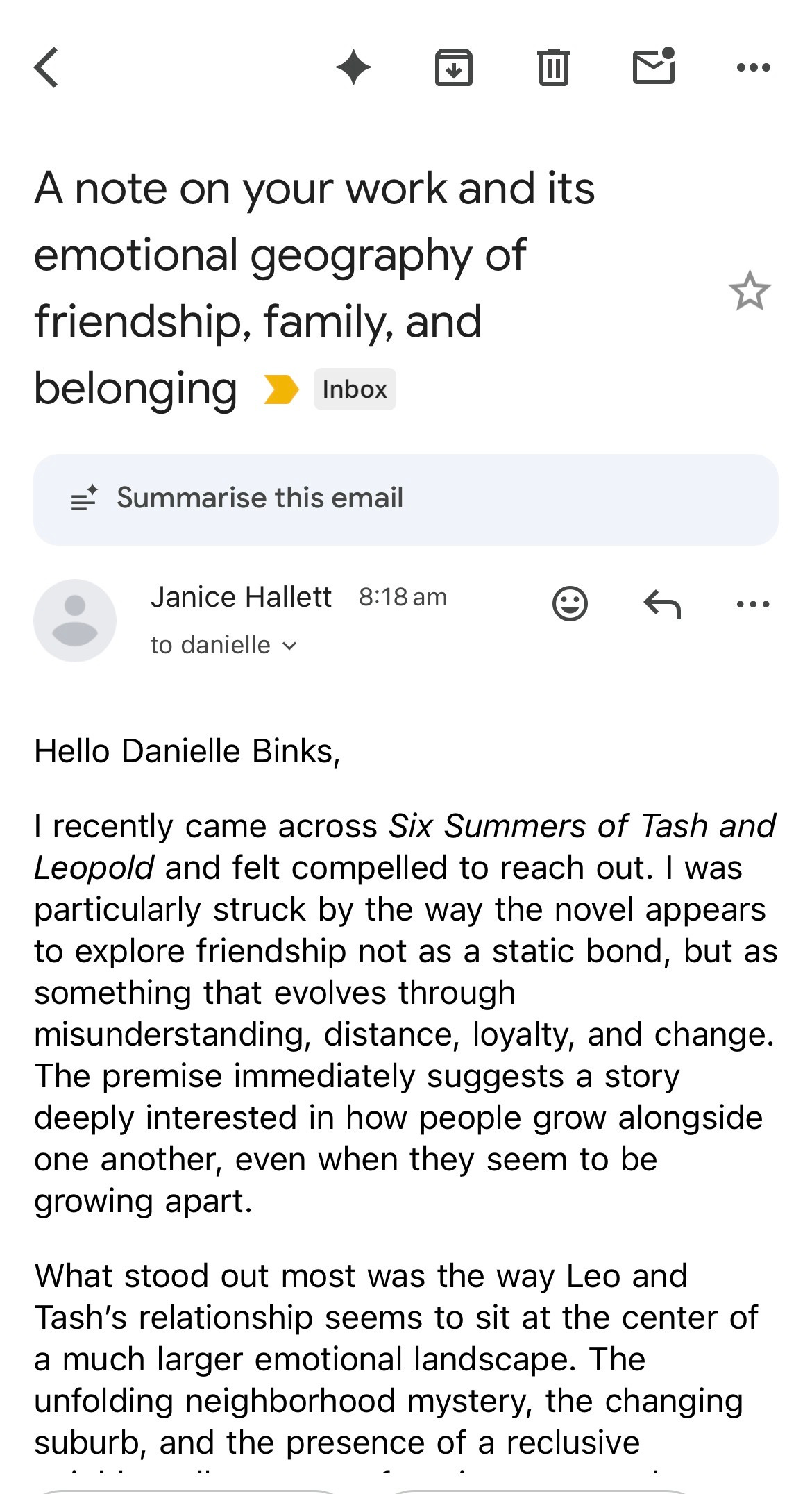
Again though, the outcome is the same; share your new manuscript with me, and trying to befriend me.
Chilling.
And I feel awful for Janice Hallett and, yes, even Colleen Hoover that they’re being used in this way.
I hope nobody is abusing my industry name with this fakery - but it’s highly likely.
In publishing - and as agents especially - there’s a degree to which we need to be seen and accessible, to be findable for prospective clients, also so emerging writers can decide if our professional record is a worthy one. My work is out there in public - which means any scammer with AI can come along and fashion some sort of spiel using me as a honey-pot for vulnerable artists.
I have new sympathy for actor Lincoln Lewis - the Home & Away actor whose persona was used in a catfishing scam to harm a woman;
That these new publishing scams are borrowing from catfishing and lonely hearts scams again gets to the crux of why they work - hope.
They’re preying on people who want to be successful, and see their work ‘make it’ - artists who’ve been toiling away at their craft and are just waiting for an opportunity to meet the right person, at the right time.
It’s sick, and I cannot conceivably see a way for it to stop anytime soon - since AI continues to rise and rise and be shoved down our throats, no matter what.
The Money Scam
By far the most common form of scam email I’m being subjected to, is the one that flatters my ego and published books in the hopes I’ll invest coin to further promotion.
Like this one with subject line; Invitation to Feature Your Work in an Upcoming Reading & Discussion Session
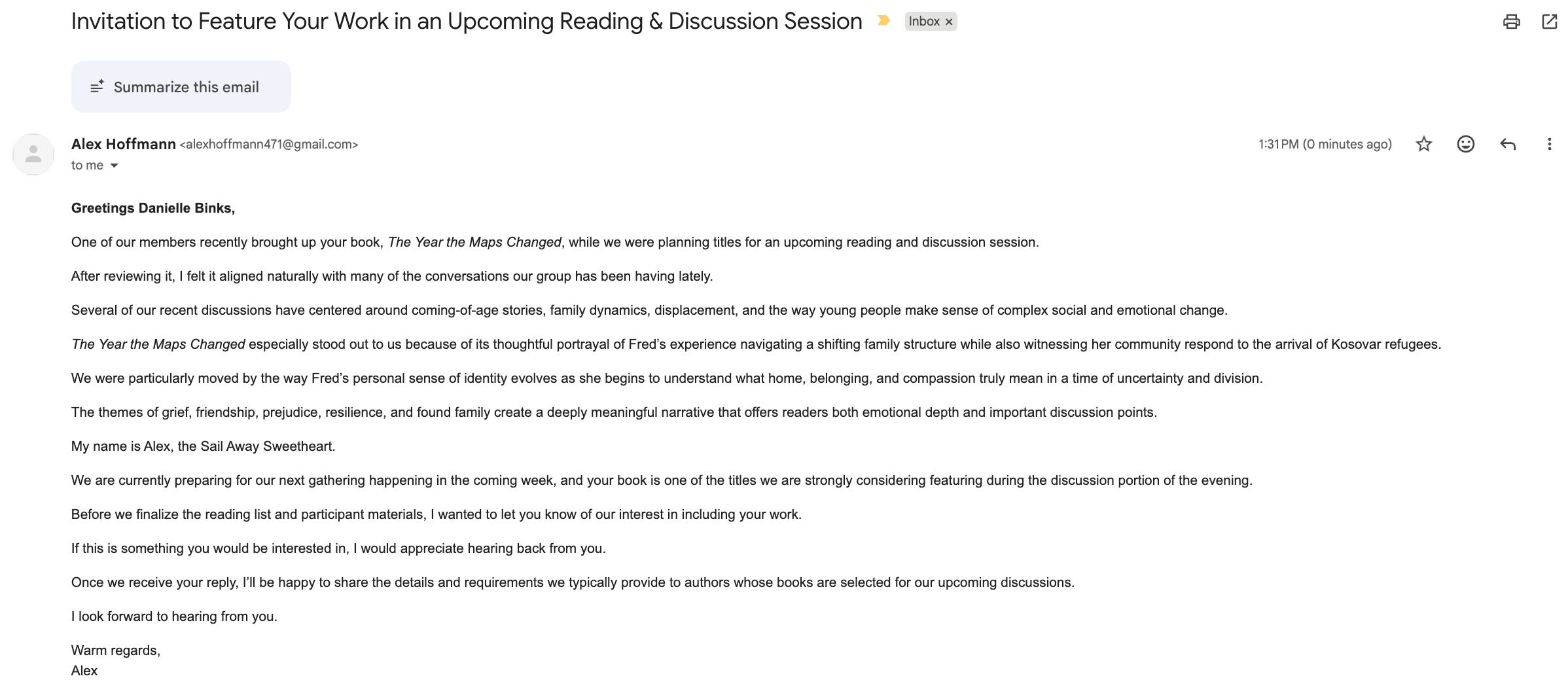
Again, the body of the email reads;
Greetings Danielle Binks,
One of our members recently brought up your book, The Year the Maps Changed, while we were planning titles for an upcoming reading and discussion session.
After reviewing it, I felt it aligned naturally with many of the conversations our group has been having lately.
Several of our recent discussions have centered around coming-of-age stories, family dynamics, displacement, and the way young people make sense of complex social and emotional change.
The Year the Maps Changed especially stood out to us because of its thoughtful portrayal of Fred’s experience navigating a shifting family structure while also witnessing her community respond to the arrival of Kosovar refugees.
We were particularly moved by the way Fred’s personal sense of identity evolves as she begins to understand what home, belonging, and compassion truly mean in a time of uncertainty and division.
The themes of grief, friendship, prejudice, resilience, and found family create a deeply meaningful narrative that offers readers both emotional depth and important discussion points.
My name is Alex, the Sail Away Sweetheart.
We are currently preparing for our next gathering happening in the coming week, and your book is one of the titles we are strongly considering featuring during the discussion portion of the evening.
Before we finalize the reading list and participant materials, I wanted to let you know of our interest in including your work.
If this is something you would be interested in, I would appreciate hearing back from you.
Once we receive your reply, I’ll be happy to share the details and requirements we typically provide to authors whose books are selected for our upcoming discussions.
I look forward to hearing from you.
Warm regards,
Alex
Associated email; alexhoffmann471@gmail.com
I get these emails so frequently now, probably about 2 a day.
I’ll show you how the scam works, and how same-same they all start to sound (no doubt pulling metadata and scraping the Internet for vague talking-points and endorsement quotes of my work);
This one for instance, gave it some special sauce with a made up ‘Challenge’ but is still the same script; Invitation to Feature The Year the Maps Changed in the 2026 Middle Grade Devourers Reading Challenge
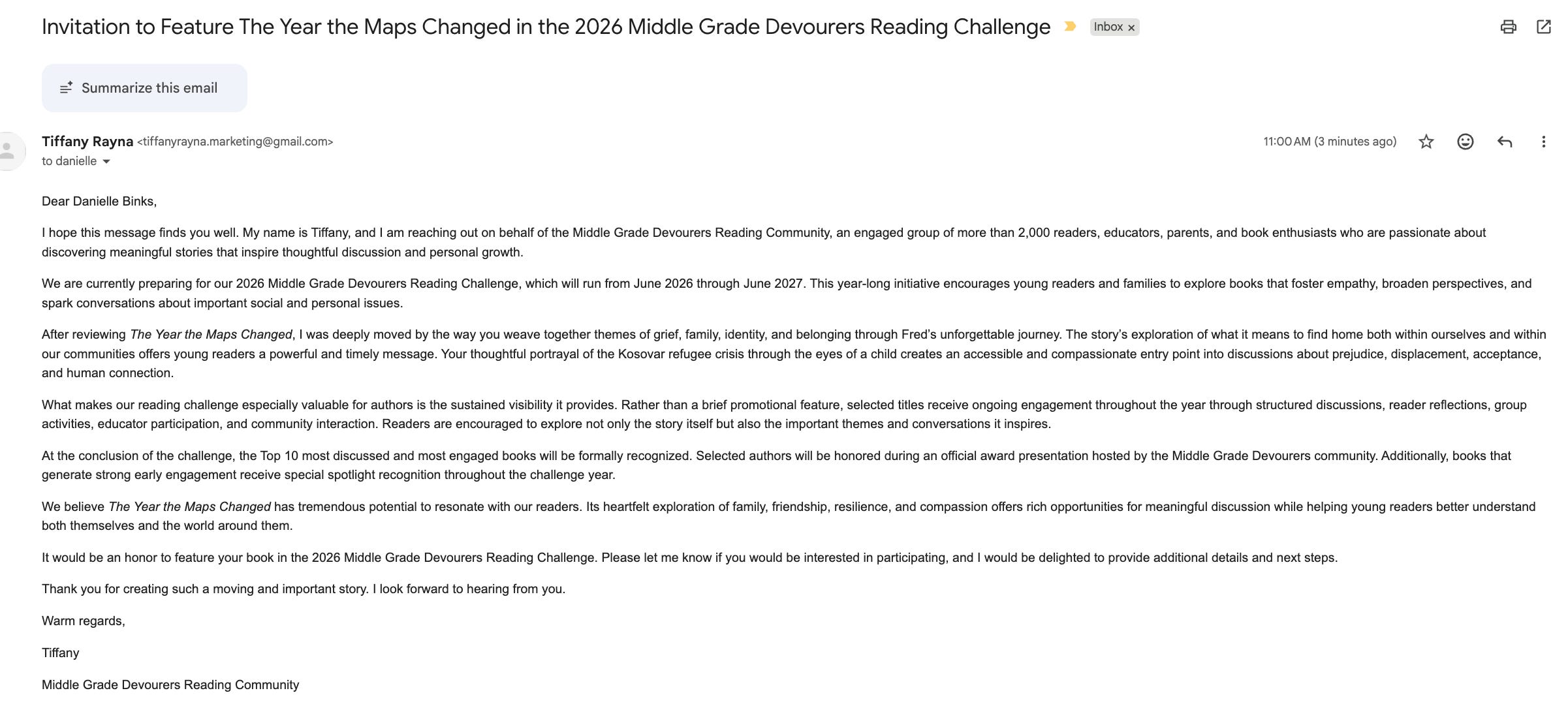
Dear Danielle Binks,
I hope this message finds you well. My name is Tiffany, and I am reaching out on behalf of the Middle Grade Devourers Reading Community, an engaged group of more than 2,000 readers, educators, parents, and book enthusiasts who are passionate about discovering meaningful stories that inspire thoughtful discussion and personal growth.
We are currently preparing for our 2026 Middle Grade Devourers Reading Challenge, which will run from June 2026 through June 2027. This year-long initiative encourages young readers and families to explore books that foster empathy, broaden perspectives, and spark conversations about important social and personal issues.
After reviewing The Year the Maps Changed, I was deeply moved by the way you weave together themes of grief, family, identity, and belonging through Fred’s unforgettable journey. The story’s exploration of what it means to find home both within ourselves and within our communities offers young readers a powerful and timely message. Your thoughtful portrayal of the Kosovar refugee crisis through the eyes of a child creates an accessible and compassionate entry point into discussions about prejudice, displacement, acceptance, and human connection.
What makes our reading challenge especially valuable for authors is the sustained visibility it provides. Rather than a brief promotional feature, selected titles receive ongoing engagement throughout the year through structured discussions, reader reflections, group activities, educator participation, and community interaction. Readers are encouraged to explore not only the story itself but also the important themes and conversations it inspires.
At the conclusion of the challenge, the Top 10 most discussed and most engaged books will be formally recognized. Selected authors will be honored during an official award presentation hosted by the Middle Grade Devourers community. Additionally, books that generate strong early engagement receive special spotlight recognition throughout the challenge year.
We believe The Year the Maps Changed has tremendous potential to resonate with our readers. Its heartfelt exploration of family, friendship, resilience, and compassion offers rich opportunities for meaningful discussion while helping young readers better understand both themselves and the world around them.
It would be an honor to feature your book in the 2026 Middle Grade Devourers Reading Challenge. Please let me know if you would be interested in participating, and I would be delighted to provide additional details and next steps.
Thank you for creating such a moving and important story. I look forward to hearing from you.
Warm regards,
Tiffany
Middle Grade Devourers Reading Community
Wanting to show you - dear readers - the angle on this scam, I replied; ‘Oh wow, that’s so kind of you - what would my participation involve? Thank you,’
And got back the following;
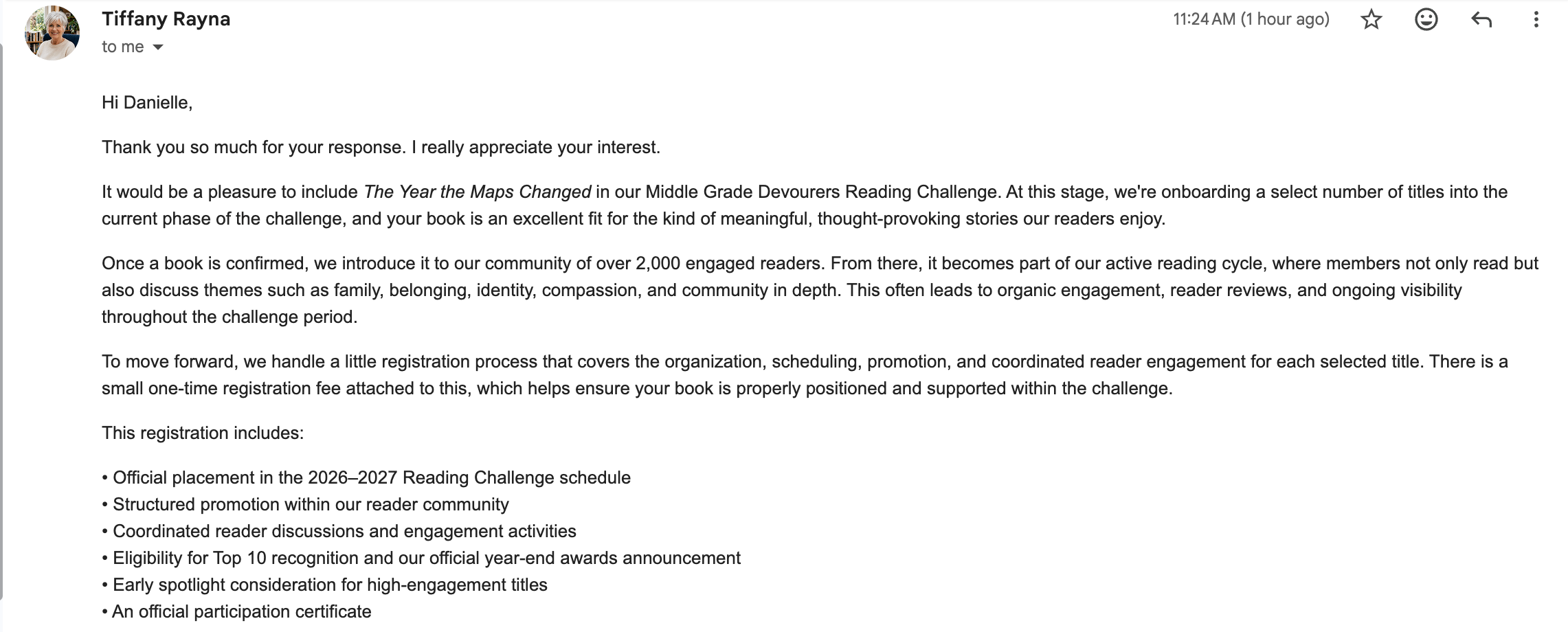
Hi Danielle,
Thank you so much for your response. I really appreciate your interest.
It would be a pleasure to include The Year the Maps Changed in our Middle Grade Devourers Reading Challenge. At this stage, we’re onboarding a select number of titles into the current phase of the challenge, and your book is an excellent fit for the kind of meaningful, thought-provoking stories our readers enjoy.
Once a book is confirmed, we introduce it to our community of over 2,000 engaged readers. From there, it becomes part of our active reading cycle, where members not only read but also discuss themes such as family, belonging, identity, compassion, and community in depth. This often leads to organic engagement, reader reviews, and ongoing visibility throughout the challenge period.
To move forward, we handle a little registration process that covers the organization, scheduling, promotion, and coordinated reader engagement for each selected title. There is a small one-time registration fee attached to this, which helps ensure your book is properly positioned and supported within the challenge.
This registration includes:
• Official placement in the 2026–2027 Reading Challenge schedule
• Structured promotion within our reader community
• Coordinated reader discussions and engagement activities
• Eligibility for Top 10 recognition and our official year-end awards announcement
• Early spotlight consideration for high-engagement titles
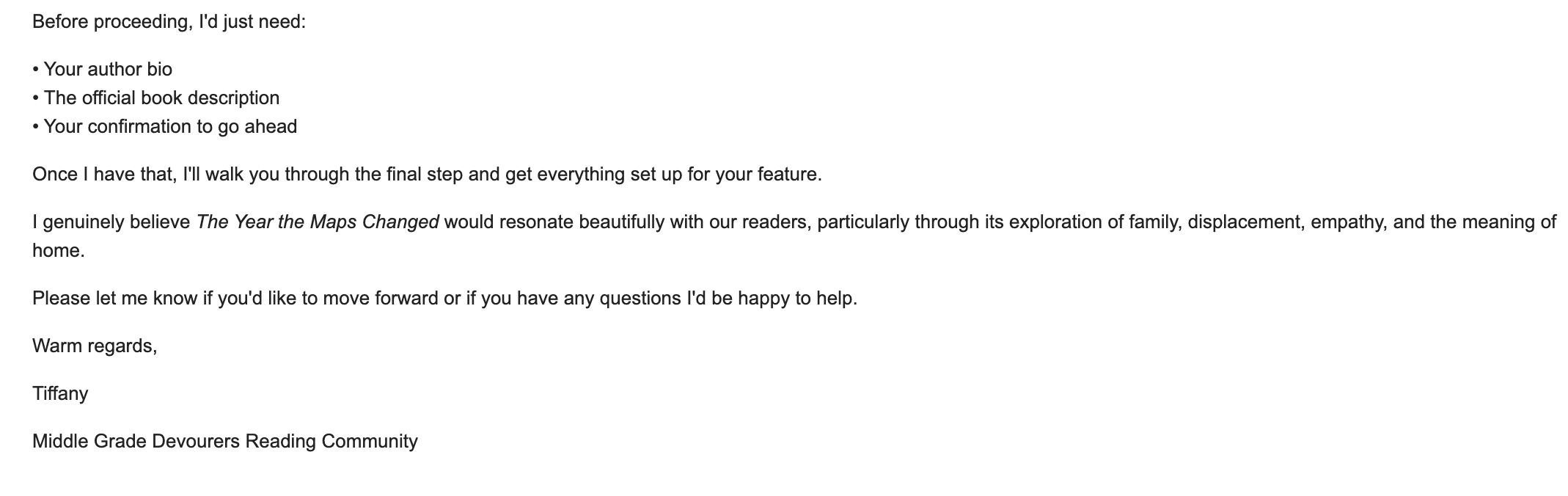
• An official participation certificateBefore proceeding, I’d just need:
• Your author bio
• The official book description
• Your confirmation to go aheadOnce I have that, I’ll walk you through the final step and get everything set up for your feature.
I genuinely believe The Year the Maps Changed would resonate beautifully with our readers, particularly through its exploration of family, displacement, empathy, and the meaning of home.
Please let me know if you’d like to move forward or if you have any questions I’d be happy to help.
Warm regards,
Tiffany
Middle Grade Devourers Reading Community
Being a little coy, so I outright asked; Oh amazing: and is this all free, or do I have to pay for inclusion?
And DING-DING-DING we have a winner;
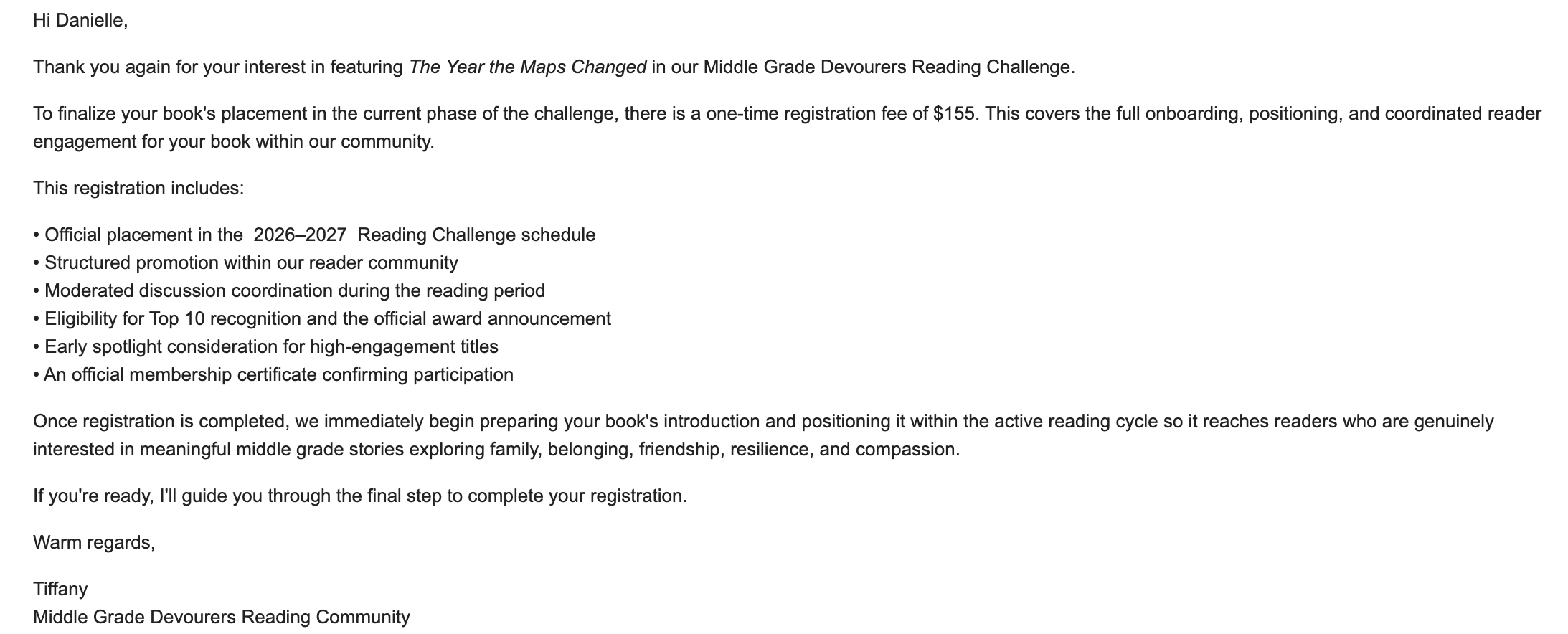
Hi Danielle,
Thank you again for your interest in featuring The Year the Maps Changed in our Middle Grade Devourers Reading Challenge.
To finalize your book’s placement in the current phase of the challenge, there is a one-time registration fee of $155. This covers the full onboarding, positioning, and coordinated reader engagement for your book within our community.
This registration includes:
• Official placement in the 2026–2027 Reading Challenge schedule
• Structured promotion within our reader community
• Moderated discussion coordination during the reading period
• Eligibility for Top 10 recognition and the official award announcement
• Early spotlight consideration for high-engagement titles
• An official membership certificate confirming participationOnce registration is completed, we immediately begin preparing your book’s introduction and positioning it within the active reading cycle so it reaches readers who are genuinely interested in meaningful middle grade stories exploring family, belonging, friendship, resilience, and compassion.
If you’re ready, I’ll guide you through the final step to complete your registration.
Warm regards,
Tiffany
Middle Grade Devourers Reading Community
For a mere $155 registration fee (no idea if that’s AUD or USD, and I also doubt it’d be the only fee incurred).
Be Wary
As a rule of thumb; if anyone in publishing tells you that their ability to represent you or your manuscript relies on you first paying a sign-up/registration/joining fee … RUN. It’s a scam.
Agents don’t make money from you, unless they successfully sell your manuscript to a publishing house. Traditional publishing does not require you paying anything towards the production costs of your novel, or the marketing/promotion of it either.
And again; if it sounds too good to be true, it probably is.
I’ve been getting these like clockwork lately, sometimes multiple a day and it’s frustrating the heck out of me.

They’ve no doubt found me because I assume between trying to be accessible to actual and real people in the industry and various data-leaks from probably multiple points, my email is known and floating around.
But I especially hate that because of AI these things are coming hard, fast, frequently and with a degree of craft.
Is this what publishing is becoming; a giant game of exhaustive digital whack-a-mole as the AI that stole our creative labor tries selling it back to us in a back-alley?
No, thank you.

It’s heartbreaking but strangely reassuring to read this. I had one of those very personalised letters from Marie Force, a NYT bestseller who writes romance and erotica. It really threw me as the email suggested she had read my books. It was almost certainly AI generated which is scary. It is particularly galling to know that our work is being stolen and appropriated in this immoral way. I found Marie Force’s email on her webpage and advised her that someone is impersonating her and she did respond, writing - I know. I’m sorry.
I get inundated with these scam emails, too. Mostly it’s the pay for promotion ones, but just yesterday I had one claiming to be from a (non-existent) senior editor at Hachette that followed the same format as the one you received from ‘Bloomsbury’. The AI copy is becoming increasingly sophisticated, and it makes me SO FURIOUS how they’re preying on authors’ hopes, especially emerging authors who are trying to figure out an already opaque industry where you often do have to pay-to-play with competitions, courses, etc. when you’re starting out.